
Tracked and Traced: Are hundreds of parking meters quietly surveilling Hamtramck residents?
The City of Hamtramck recently installed over 600 new parking meters equipped with surveillance cameras. What are city officials, or the company who operates the meters, doing with that footage?
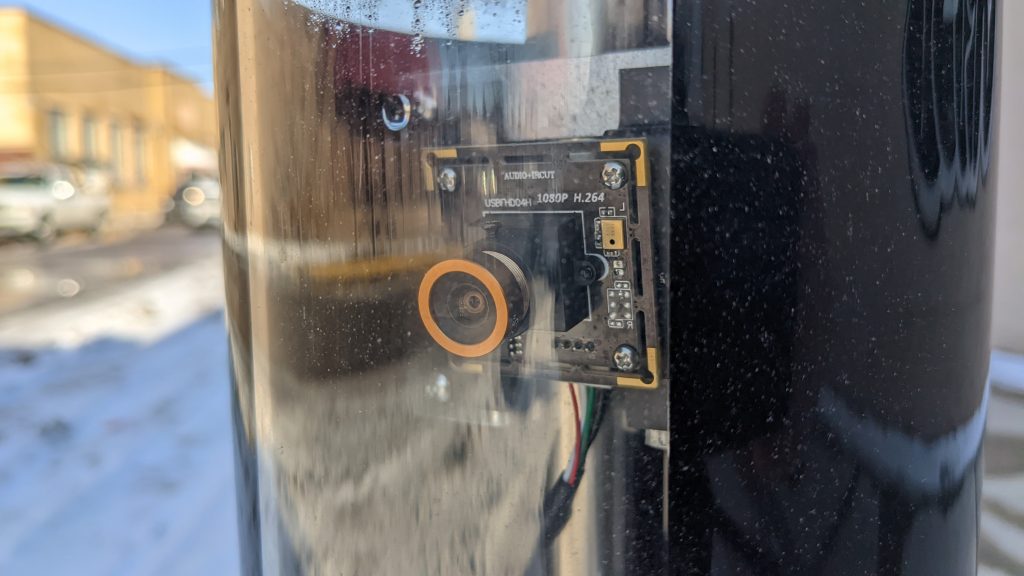
There are over 600 parking meters equipped with cameras on Joseph Campau Avenue in Hamtramck.
Listen and subscribe to Tracked and Traced:
Apple Podcast — Spotify — NPR — Stitcher — Google PodcastsIn this episode:
- Investigating Hamtramck’s new parking meters
- Interview with Kelsey Finch, former Senior Counsel for the Future of Privacy Forum, on the state of surveillance and privacy policy in U.S. cities
A quest for answers
All down Joseph Campau Avenue, the main business corridor in Hamtramck, which is the densest city in Michigan, there are futuristic-looking poles popping out of the ground — those are the new parking meters. If you get up close and look in the black bands that are at the top of each pole then you can see the cameras pointing out.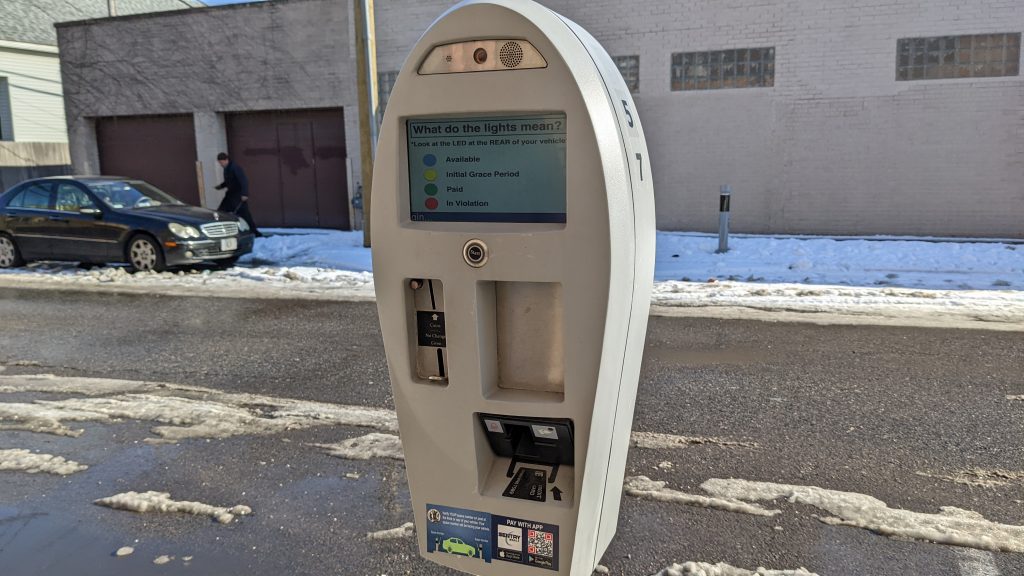
“It’s particularly frustrating and concerning because this is a community of immigrants who probably don’t know that there are cameras where they park their car.” —State Rep. Abraham AiyashThat left me wondering if only police have access, or can the public get ahold of the images, too? So, in December 2021, I did an experiment. I stood in a parking spot and waved at a parking meter camera. Then I tried to obtain the footage through a Freedom of Information Act request. A city official said they would normally be available, but the meters and cameras were off for the city’s annual holiday parking reprieve, so I couldn’t get them. Another dead end. Maybe I can’t get the images right now, but there has to be a privacy policy, right? Wrong. City Council approved the cameras in 2020, and I figured those issues came up. I listened to recordings of three council discussions on the meters from late 2019 and early 2020, but council members barely asked about privacy. Like Council Member Anam Miah, most thought they were a great idea. “We need to move our community into the 21st century,” Miah said. “I think it’s going to be even more convenient for individuals who come and shop to know that they can open the app and tap and go. Some of those features is really unique and people are ready for it.” In that same council meeting, a representative from MPS says the parking meters do record video, but the city would have to pay extra to store the footage and access it later for investigations. “All that data is overwritten quickly if the city doesn’t want it. If you want, you got it, if you don’t want it, then it goes away,” the company rep says. That raised a new question: Was Hamtramck paying to store footage? If not, how soon does the video “go away”? And I still had no answers about privacy. I called the police chief for clarification. Three times. No response. I contacted MPS multiple times. No response.
The quest continues
Then, I spoke with Carrie Beth Lasley, a former council member. She wasn’t on council when the meters were approved so she didn’t have answers, but she said she opposes the cameras. “I’m concerned about privacy issues. I’m concerned about who has access,” she said. “This provides a lot of power to someone who may want to use it in a malicious way.” She wasn’t surprised I was having trouble getting answers from the council meetings. “This is a pretty dramatic change without a whole lot of thought or reading and making sure we know who we’re doing business with,” she added. I figured the answers to the remaining questions were likely in the contract between the city and MPS. So I checked the council’s publicly available documents for the contract, but it wasn’t there. That seemed odd. It appeared much of downtown suddenly had cameras pointed at it and the details of that plan weren’t even included in the council packet. Fortunately, Lasley had a copy of the contract so she shared it with me. Unfortunately, like everything else, the contract answered some questions, but raised more. It states that MPS can share depersonalized data with third parties. Who does MPS share it with and who at city hall has access? What happens if the FBI wants to take a look at the data? And the biggest unknown: Is the city paying for MPS to store video images? If not, how long is MPS keeping the footage of Hamtramckans on its servers? The contract didn’t say. That seemed crazy, but at this point, I had talked with former council members, city residents, a police officer, listened to three council meeting recordings, and read the contract but I still didn’t know what exactly was going on. It became evident that only one person could or would be able to fill me in: City Manager Kathy Angerer.Some answers
In an initial phone call, Angerer said the cameras aren’t used as an investigative tool. When I pointed out that an officer told me they were for the hit and run, she said the images were available because the crime occurred in the parking spot. She added that the cameras might be used to help investigate a major crime, like a bank robbery. She also said the cameras don’t collect video. They collect a series of still images. But, technically, video is a series of still images, and the meter company refers to it as video. When we talked again, Angerer had clarifications: “What you described to me about video monitoring sidewalk activity — absolutely not,” she said. If there was a crime, then police could look at still images of license plates in the area, she added, but: “We didn’t purchase the component that would show the storefronts or pedestrians or be that big brother component,” she said. “We simply purchased the system that is there to monitor parking.” And the only people who have access to the still images are Angerer, the city’s public safety liaison and police officers.“We didn’t purchase the component that would show the storefronts or pedestrians or be that big brother component. We simply purchased the system that is there to monitor parking.” —Kathy Angerer, Hamtramck city managerBut, wait: What about the police officer who told me they use the meters’ video footage? “There’s no video at all, it only stores pictures, not sure who you spoke to but they were mistaken,” Angerer said. Angerer asked for the officer’s name but I didn’t have it. So she directly questioned my reporting skills. Touché. But that’s also partly why I called the chief three times to ask for clarification, tried contacting the company and ultimately ended up on the phone with her. It seems that many in the city might agree that Angerer and the Hamtramck police are doing the right thing by not paying to access video, and should be applauded for that. Still, the cameras and infrastructure are in place, and city officials could later pay for more of the options offered by MPS. After all, the city did decide to put video surveillance cameras in one of the parks where many of the town’s Muslim residents gather. Though, as with the meters, it had the support of most Muslim city council members.
‘This is not some boogeyman’
Surveillance is a sensitive issue here. Hamtramck is home to a majority Muslim population, and the relationship between Muslim residents and Hamtramck police has at times been strained. “There’s a precedent. This is not some boogeyman that we are concocting,” State Rep. Aiyash said. “People in this community were literally profiled, harassed and targeted because of Islamophobia and other reasons and we have to make sure they are protected.” Like other residents I spoke with, Aiyash still sees the placement of video cameras in Hamtramck as a step in the wrong direction. After 9/11, Muslim communities in the U.S. were targeted, harassed, and interrogated by law enforcement agencies. He called companies tracking or surveilling people on the web and walking down the street “creeping surveillance.” “That should raise a lot of concerns, and I think people should always know how they’re being tracked, when they’re being tracked, and what the purpose is,” Aiyash added. “And the problem here right now, from what I understand, is there’s no clear understanding of how or what or if this data is stored and who it can be sent to. “Dare I say this could lead to techno fascism and that’s something we have to be very careful about.” Despite all my investigating, some things still aren’t clear. It seems that the cameras are shooting video, and footage may be stored by MPS for some time before it’s deleted, though Hamtramck isn’t paying for that at the moment. But with a private company owning the parking meter footage and no clear privacy policy, Hamtramackans are left wondering who’s watching them downtown. Related episodes- Tracked and Traced: You are the product, thanks to surveillance capitalism
- Tracked and Traced: How thousands of American Muslims ended up on the terrorist watch list
- Tracked and Traced: Does Project Green Light in Detroit reduce crime?