Tracked and Traced: Safety vs. Surveillance in Dearborn Public Schools
Dearborn Public Schools is one of many districts ramping up security efforts in response to mass shootings, but some warn the methods could have harmful consequences.
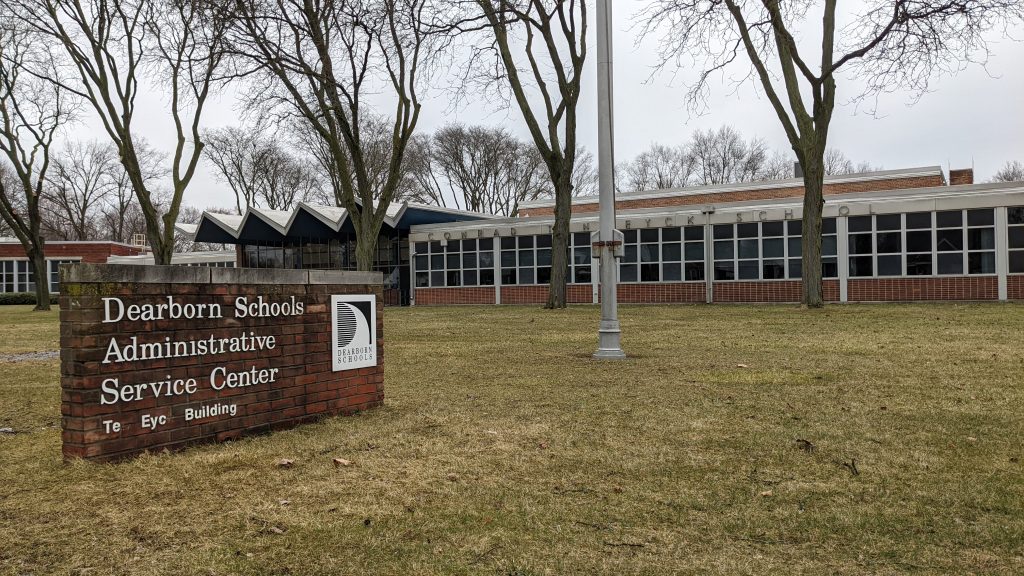
Dearborn Schools Administrative Service Center.
Listen and subscribe to Tracked and Traced:
Apple Podcast — Spotify — NPR — Stitcher — Google PodcastsIn this episode:
- New agreement between schools and police in Dearborn for live feeds of high schools
- Chris Gilliard on digital proctoring and surveillance of students
“I would like to hear, like, a real life scenario where what they’re asking for is actually going to help. Because based on what we know from previous shootings, it happens fast.” — Daniel DomitarLeonard Wright moves toward the microphone and casts doubt on the plan. “Technology is a great thing,” he says. “But everybody sitting up here recognizes that it has been used for nefarious means.” Daniel Domitar takes his turn. He questions whether the agreement could be effective in stopping a tragedy at all. “I would like to hear, like, a real life scenario where what they’re asking for is actually going to help. Because based on what we know from previous shootings, it happens fast,” he says. “By the time they figure it out, it’s too late. The damage is done. How is this going to prevent that?” But Superintendent Maleyko says too much is at stake if they fail to prepare. “I do not want to be here down the line to say only if we used the technology that we had, that could have saved the life of a child,” he says. After about an hour of discussion, council members unanimously approved the agreement between schools and the police.
‘Seconds Count’
Learning institutions across the nation are facing increasing pressure to keep students and staff safe. School shootings were on the rise last year — 34 took place at K-12 schools, according to an Education Week analysis. Amid the COVID-19 pandemic, in 2020 there were 10. In 2018 and 2019 there were 24. Experts stress that school shootings remain statistically rare. But Dearborn Public Schools, which serves over 20,000 students, is preparing for these worst case scenarios.
The evolving school surveillance landscape
The use of video surveillance systems in schools is not new. Most K-12 districts have some type of camera system monitoring spaces inside buildings. Generally, they exist to secure school campuses but also deter bad behavior. And at least three states have passed laws allowing districts to install video cameras in special education settings. They say the legislation is to protect students from potential abuse or clear a teacher’s name if accused of inappropriate conduct. While Fourth Amendment rights protect people from unreasonable searches and seizures, some legal scholars have pointed out that these protections have declined for students over the last three decades. A series of Supreme Court rulings gave school officials more power to enforce orderly and safe environments, which paved the way for more heightened school surveillance systems. In the era of school shootings, new technologies have accelerated. Odis Johnson Jr. is the executive director of the Johns Hopkins University’s Center for Safe and Healthy Schools. “We’re also seeing the introduction of AI and facial recognition technologies,” he says. “And they’re now building school buildings with holes above the door so that drones can fly in.” And when students began learning virtually during the COVID-19 pandemic, more digital surveillance came with it. Some districts hired third party companies to monitor student email accounts or social media activity, or purchased software that tries to detect cheating.More school surveillance may create “a climate of fear”
With all of these sophisticated technologies, has surveillance actually been effective in stopping a school shooting? Johnson says no. “There is no connection between the presence of these technologies and surveillance, and rates of school shootings,” he says. “So I think that’s really important, we have no evidence that the inclusion of SROS or video footage has somehow made the shootings less likely.” SROs stands for school resource officers, which are basically police officers assigned to schools. In fact, Johnson says that studies, including his own research, reveal something else: these systems often disproportionately harm students of color. “We do know that the presence of these technologies do in fact — relate to higher suspension rates, higher exclusionary discipline, and higher referral rates to authority,” he says. “It really does impact kids’ perspectives about schools, whether they’re safe, whether they’re themselves perceived as suspects, when they come to school. Those things then relate to feelings of school connectedness, belongingness, trust.”“I’m offended by it, because that is not what we as educational professionals are here to do.” — David Mustonen, Dearborn Public SchoolsSome Dearborn activists have been critical of the district’s agreement because they worry the cameras will be used to prosecute Black and brown students. Alexandria Hughes is an activist with Accountability for Dearborn. Hughes says school surveillance creates “a climate of fear.” “In school, you’re there to learn and, you know, make friends, to grow up and learn different lessons and to develop in schools,” she says. “They shouldn’t have to worry about being arrested. And you know, that’s a bit concerning because this is children. These are people who are just trying to become the best version of themselves.” David Mustonen is the Communications Director for Dearborn Public Schools. He rejects claims that the technology will be used to target and discriminate against students. “It really insults me to think that somebody dares, says that this district — and all that we are doing, and all that we have done throughout the years, and the number of resources that we put forth, to make sure that students are successful with a 95% graduation rate in this district — that someone would insinuate that we are here to put kids in prison,” he says. “I’m incensed by that. I’m infuriated by that. And I’m offended by it, because that is not what we as educational professionals are here to do. And that’s not what we do in Dearborn.” Abbas Wazne is a sophomore at Fordson High School in Dearborn. He says he has mixed feelings on the situation, adding that many of his classmates aren’t aware of the district’s agreement with the local police. On one hand, Wazne says it is the job of the police to keep students safe and it doesn’t bother him if he and his classmates are monitored in the event of a real threat. But all this surveillance still makes him feel uncomfortable. “And it’s weird because like, school’s supposed to be a safe place,” Wazne says. “But now they’re watching us and they’re being able to listen to us wherever we are.”
A Broken Trust
Dearborn residents have a reason to be skeptical of being watched. With the draw of the auto industry attracting immigrants from countries like Lebanon, Iraq, and Syria since the early 1900s — Dearborn is now known as the city with the highest concentration of Arab-Americans in the United States. Following the 9/11 attacks, Arab and Muslim families in the city became a target for government surveillance and humiliating harassment — all in the name of national security. “I think a school setting should be a safe setting for parents, students, families to enter without the worry of, ‘am I being recorded right now, who is seeing this?’” says Zienab Fahs, the safe spaces director at Michigan’s chapter of the Council on American Islamic Relations.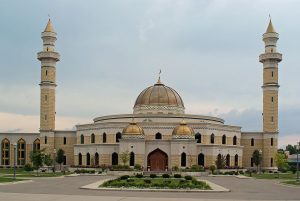
‘A nationwide tragedy’
Two months after the city council meeting in Dearborn, tragedy struck 35 miles away. The city of Oxford, Michigan, suffered immeasurable grief and loss when a 15-year-old sophomore allegedly opened fire at Oxford High School, killing four students. The suspect has since been charged as an adult and is facing 24 counts, including first degree murder and terrorism. His parents have also been charged with involuntary manslaughter.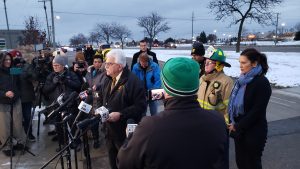
- Tracked and Traced: Does Project Green Light in Detroit reduce crime?
- Tracked and Traced: Does ShotSpotter prevent violent crime in Detroit?
- Tracked and Traced: You are the product, thanks to surveillance capitalism